

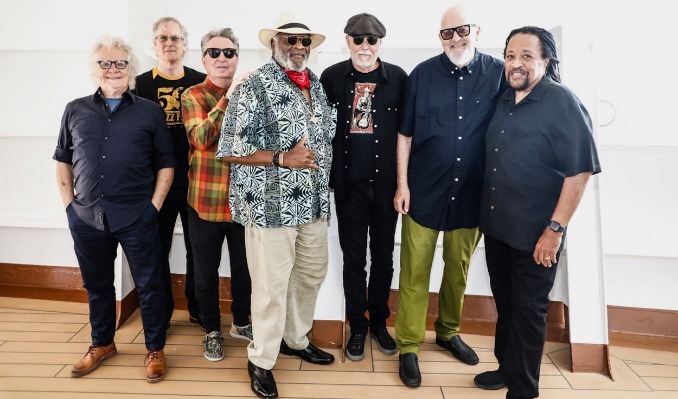
Taj Mahal’s career has been full of and defined by colorful twists and turns, unexpected whimsical ventures and a commitment to a muse that has long preferred freewheeling innovation to conformity. So there’s always the challenge of finding the right words and phrases to capture just what he’s meant to American music over the past half century. The parents of Harlem born Henry St. Claire Fredericks, Jr. (Mahal’s given name until his dreams of Gandhi, India and social tolerance inspired him to change it) came of age during the Harlem Renaissance and instilled in their son a sense of pride in his West Indian and African ancestry. Growing up in Springfield Massachusetts, Mahal’s father was a jazz pianist, composer and arranger of Caribbean descent (called “The Genius” by Ella Fitzgerald) who frequently hosted musicians from the Caribbean, Africa and the U.S. His mother was a schoolteacher and gospel singer from South Carolina. Henry Sr. had an extensive record collection and a shortwave radio that brought sounds from across the world into their home. Back in the 1950s, Springfield was full of recent arrivals from all over the globe, allowing Mahal to understand and appreciate many world cultures. In addition, musicians from the Caribbean, Africa and all over the U.S. frequently visited the Fredericks home, and Mahal became even more fascinated with roots – the origins of the various forms of music he was hearing, the path they took to reach their current form, and how they influenced each other along the way. He threw himself into the study of older forms of African-American music, which the major record companies of the day largely ignored. Mahal’s parents started him out on classical piano lessons, but he soon expanded his scope to include clarinet, trombone and harmonica and discovered his talent for singing. His stepfather owned a guitar and Mahal began playing it in his early teens, becoming serious when a guitarist from North Carolina moved in next door and taught him the various styles of Muddy Waters, Lightnin’ Hopkins, John Lee Hooker and Jimmy Reed and other titans of Delta and Chicago blues. Before music became a viable option, Mahal – who first began working on a dairy farm at 16 and was a foreman by 19 – thought about pursuing a career in farming. Over the years, this ongoing passion has led to him performing regularly at Farm Aid concerts. In the early 60s, he studied agriculture (minoring in veterinary science and agronomy) at the University of Massachusetts at Amherst, where he formed the popular U. Mass party band, the Elektras. After graduating, he headed west in 1964 to Los Angeles, where he formed the Rising Sons, a six-piece outfit that included guitarist Ry Cooder.